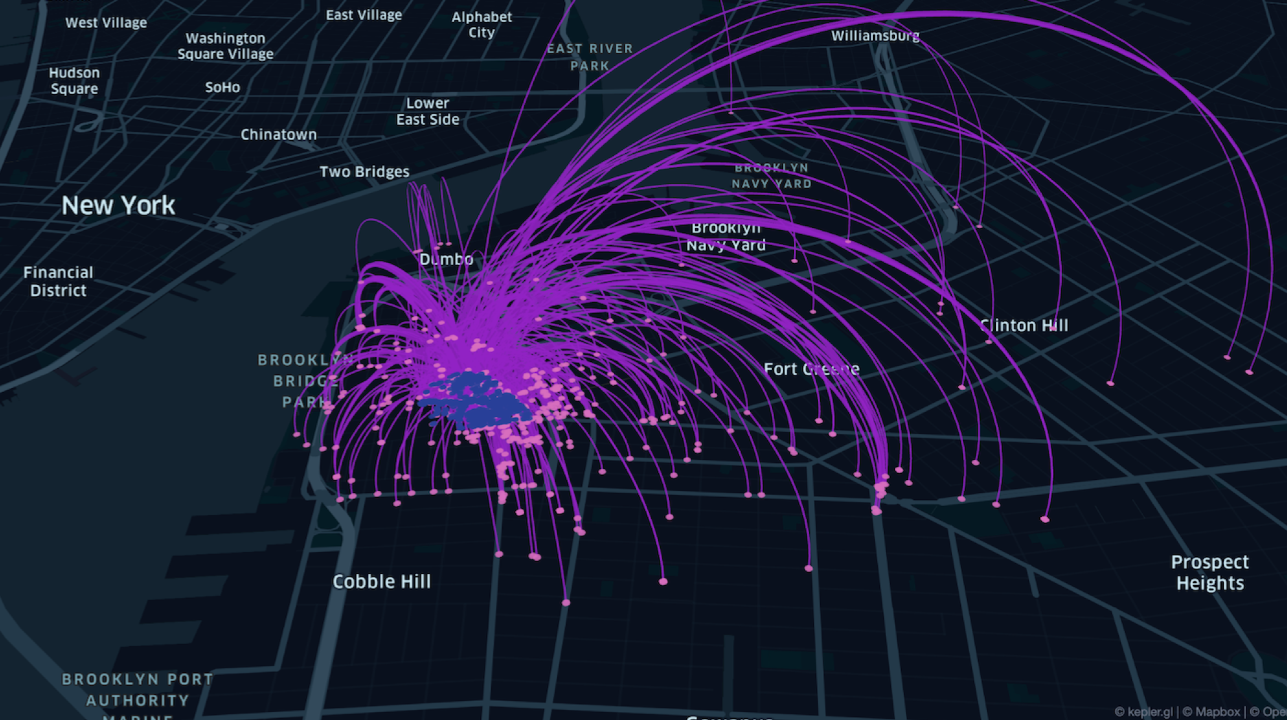
What if you could predict how a new coffee shop might affect foot traffic on Fulton Street before it opens? A new research collaboration between NYU Tandon’s Resilient Urban Networks Lab and Downtown Brooklyn Partnership is making that possible.
Led by NYU Assistant Professor Takahiro Yabe, the project uses anonymized mobile location data and large language models (LLMs) to model how people move through Downtown Brooklyn and what influences where they choose to spend time and money. The result is a practical planning tool that can help property owners, retailers, and planners make smarter and more informed decisions.
At the heart of the project is a synthetic population of about 20,000 AI agents – digital representations of the people who live, work, and visit Downtown Brooklyn. Built using mobile phone data, demographics, and business attributes, these agents simulate real-world behavior. Yabe describes it as building something like SimCity, but grounded in real human behavior.
The system lets researchers and planners run what-if scenarios: What happens to foot traffic if a new grocery store opens? How does the neighborhood respond when a popular café closes? Where should a new tenant relocate to attract the most visitors and encourage them to stay longer?
The project was part of NYU CUSP’s capstone program and was presented in May at the Urban Data Science Showcase at NYU’s Downtown Brooklyn campus. It was led by CUSP graduate students Sizhe (Alex) Xu and Divya Natekar, with Ph.D. students DongHak Lee and Boyang Li serving as mentors.
Downtown Brooklyn Partnership supported the project by identifying practical use cases and contributing local knowledge about business openings, closures, and prospective tenants. The resulting tool enables DBP to simulate how foot traffic and consumer demand may shift when a new business opens or closes – even before those changes occur. This capability allows DBP to bring concrete, data-driven recommendations about which types of businesses are most likely to succeed in specific locations.
One early finding underscores how tightly linked the neighborhood’s retail ecosystem is. When researchers simulated the closure of a popular coffee shop, the model showed customer demand spreading across multiple nearby businesses rather than shifting to the nearest competitor. That pattern points to the idea that Downtown Brooklyn’s businesses share and redistribute foot traffic, and diversity and proximity are essential to neighborhood vitality.
The model has also proven highly accurate at predicting everyday movement patterns, particularly with predictable routines like weekday lunch trips, and has been validated against real-world business openings and closures.
While the current analysis focuses on restaurant visits, the framework is built to scale and applicable to a wide range of retail and urban planning questions, from tenant mix to long-term neighborhood development strategy.
For DBP, this research represents a new kind of innovative resource that turns the everyday movements of thousands of people into clear, actionable guidance for building a stronger Downtown Brooklyn.