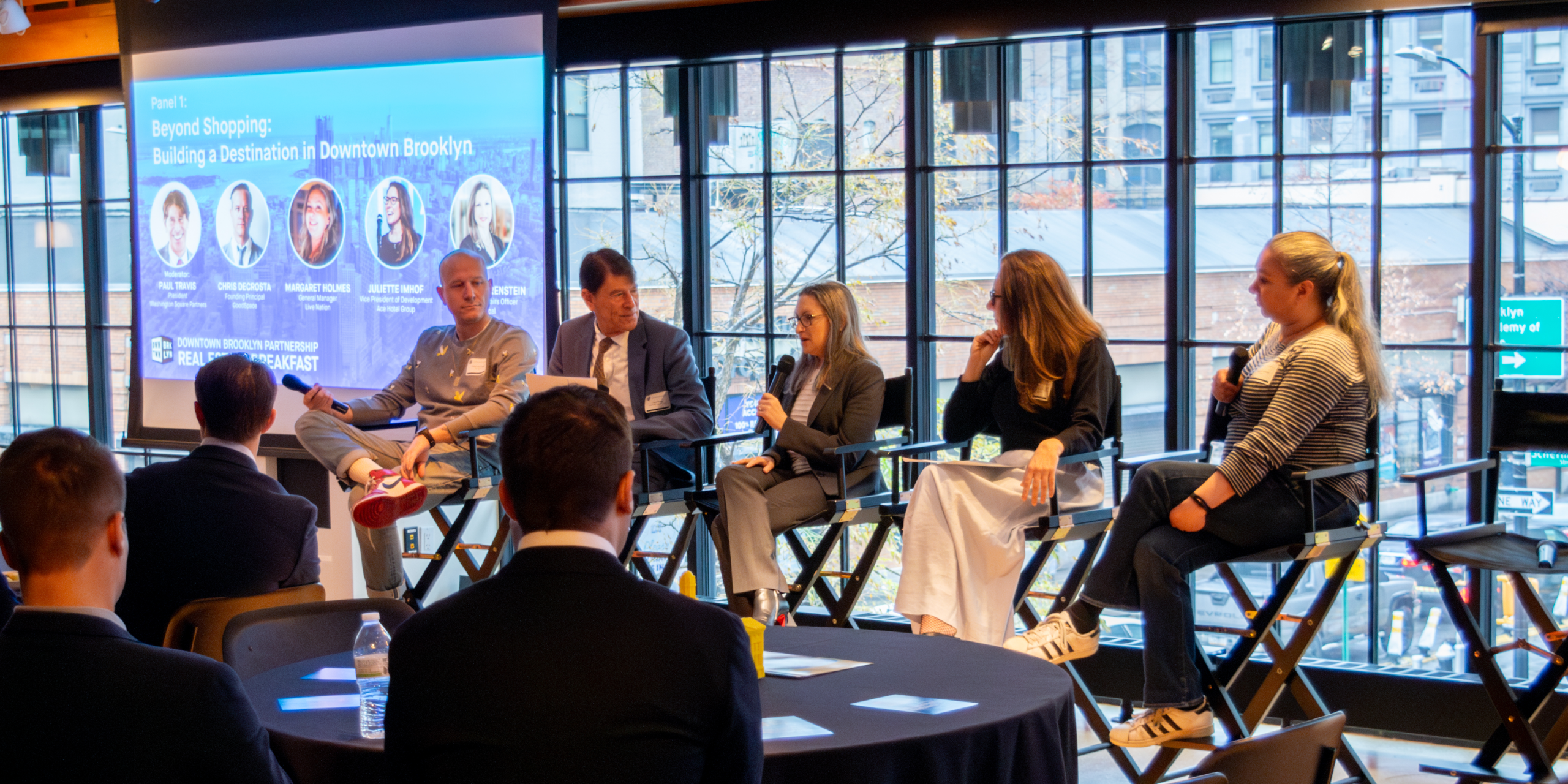
On a rainy November morning, Downtown Brooklyn’s leading voices gathered at the Ace Hotel Brooklyn for Downtown Brooklyn Partnership’s annual Real Estate Breakfast. The message was clear: Downtown Brooklyn’s transformation is accelerating — powered by confidence, diversity, and a growing mix of experiences that reinforce it as a place where people want to be.
DBP President Regina Myer opened the event alongside Board Chair and Alloy CEO Jared Della Valle. Their remarks reflected what the room already felt: the neighborhood is entering a bold new phase.

Beyond Shopping: Building a Destination
Downtown Brooklyn’s shift from office district to mixed-use hub began 20 years ago. Today, that early start is paying off. The first panel — focused on retail and entertainment — included Chris DeCrosta of GoodSpace; Marissa Shorenstein of BSE Global; Juliette Imhof of Ace Hotel Group; and Margaret Holmes of Live Nation/Brooklyn Paramount, moderated by Paul Travis of Washington Square Partners and City Point.
Travis highlighted record momentum at City Point: new leases from Warby Parker, Swarovski, and Just Salad, plus record foot traffic and sales at DeKalb Market. Barclays Center remains a top 10 international arena, and Shorenstein described BSE Global’s continued investment in the borough, including an 80,000-square-foot New York Liberty training facility in Greenpoint, new retail coming to One Hanson’s bank hall, and a temporary youth basketball training facility at the former Modell’s on Flatbush Avenue.
Brooklyn Paramount, open just 19 months, has already welcomed more than 300,000 visitors and is on track for 400,000 this year. Holmes emphasized its wide-ranging programming — metal, rock, hip hop, even a Steph Curry book event — positioning the venue as a major cultural anchor.
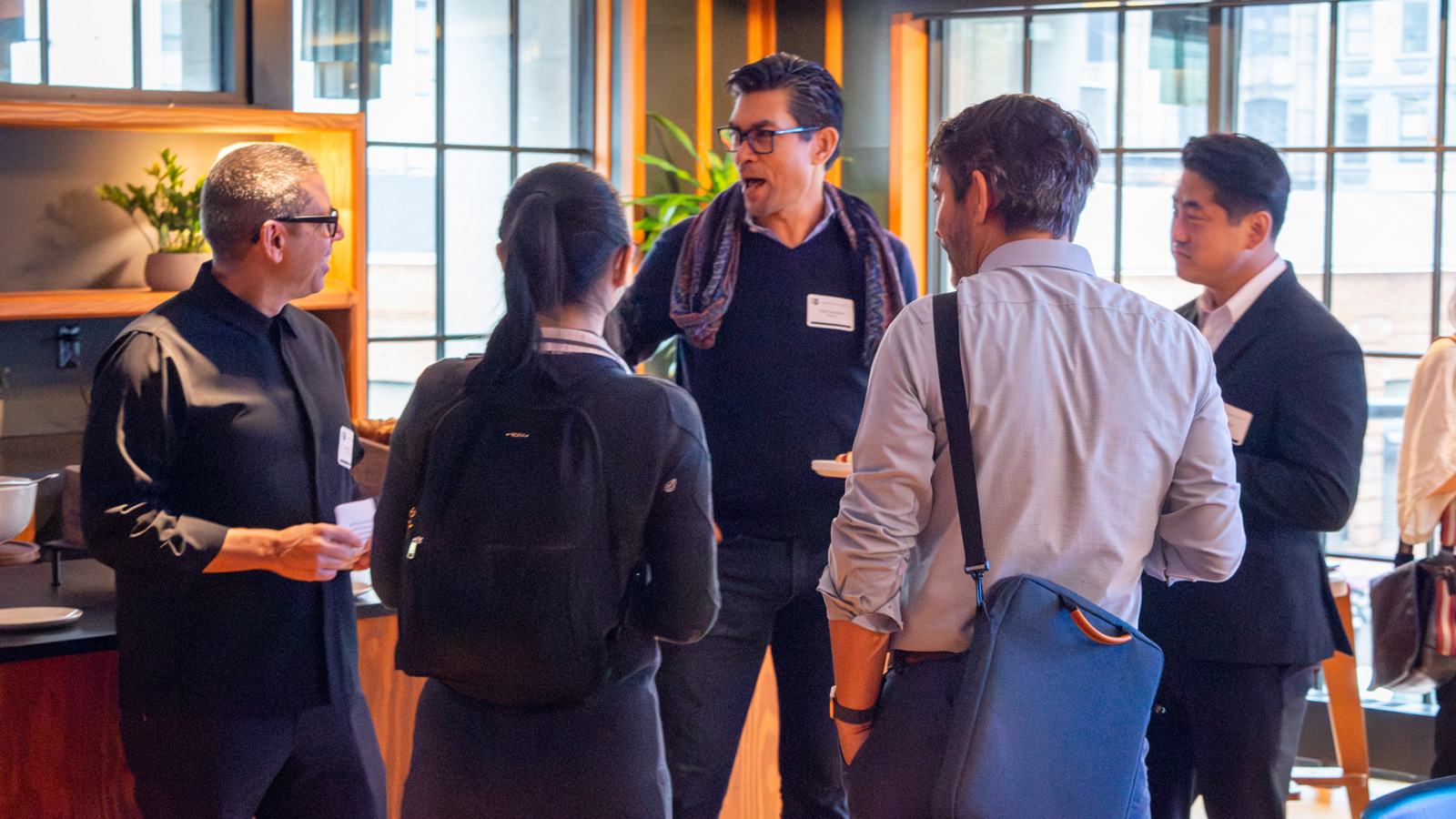
The Ace Hotel Brooklyn illustrated a broader market shift. When the project was first signed in 2014, Brooklyn was considered an “overflow market.” Today, the Ace outperforms its NoMad counterpart. “This hotel is about 50% higher than others in Brooklyn on a revenue-per-available-room basis,” said Imhof. Its guests include international travelers drawn to Barclays, BAM, and Brooklyn Paramount, as well as New Yorkers who are choosing the Brooklyn experience over Manhattan.
This new customer base is fueling retail demand. Din Tai Fung selected Downtown Brooklyn with little persuasion. “They knew their customers were here,” said DeCrosta. He sees Fulton Street becoming a Fifth Avenue–style corridor: dense, walkable, and highly accessible, with 13 subway lines feeding it. Within five years, he predicts it will be the borough’s premier shopping and entertainment district.
Panelists agreed that the next frontier is nightlife and third places. “We’re dumping a lot of people onto the streets after shows with nowhere to go,” said Holmes. Imhof echoed that several years ago, Downtown Brooklyn lacked places to meet. Shorenstein noted that BSE Global is actively investing to help close that gap.
Across the board, confidence is rising: the Ace Hotel team now wishes it had built bigger, Brooklyn Paramount is expanding programming, and Barclays is investing heavily in enhancing the Brooklyn experience.
Residential Growth
The second panel, led by DBP Senior Director of Real Estate + Economic Development Mark Landolina, included Alloy CEO Jared Della Valle; Silverstein Capital Partners Managing Director Gabe Randall; Rabina Senior Vice President Ian Klein; Lonicera Partners Co-Founder Jamie Anthony; and Citizens Housing and Planning Council Executive Director Howard Slatkin.

Landolina opened by noting that since the 2004 rezoning, Downtown Brooklyn has added more than 27,000 housing units, with another 5,000 expected in 2025 alone.
Anthony described Downtown Brooklyn as a “place of opportunity,” centrally located among many of the city’s most desirable neighborhoods. Lonicera has delivered more than 1,000 units, and he said demand remains strong, reinforced by the cultural and retail ecosystem highlighted in the earlier panel.
Della Valle said Brooklyn continues to attract a diverse, vibrant population and pointed to Alloy’s all-electric, carbon-neutral tower as an example of the neighborhood’s forward momentum.
Residential performance reflects this confidence. The Brooklyn Tower has reached 70% occupancy, with stronger leasing and sales since its summer relaunch under Silverstein Capital Partners. Randall highlighted new amenities, including a flagship Lifetime club opening next month.
Klein described the evolution of Rabina’s 295 Flatbush Ext. Project – a 72-story mixed-use tower made feasible by City of Yes zoning enabling 23 FAR. Building above a subway station increased complexity, but he emphasized strong community and political support for new housing.
Policy momentum is also shifting. “We just had a referendum to make it easier to build affordable housing—and it passed,” said Slatkin, reflecting voter support for expanding supply. Yet challenges remain, particularly with the new 485-x tax incentive, which raises costs for projects over 100 units. ULURP can help, Anthony noted, but is time-consuming and expensive.
Still, panelists agreed the neighborhood has strong fundamentals, supported by a mix of long-term owners and new generational investors committed to the district’s future.
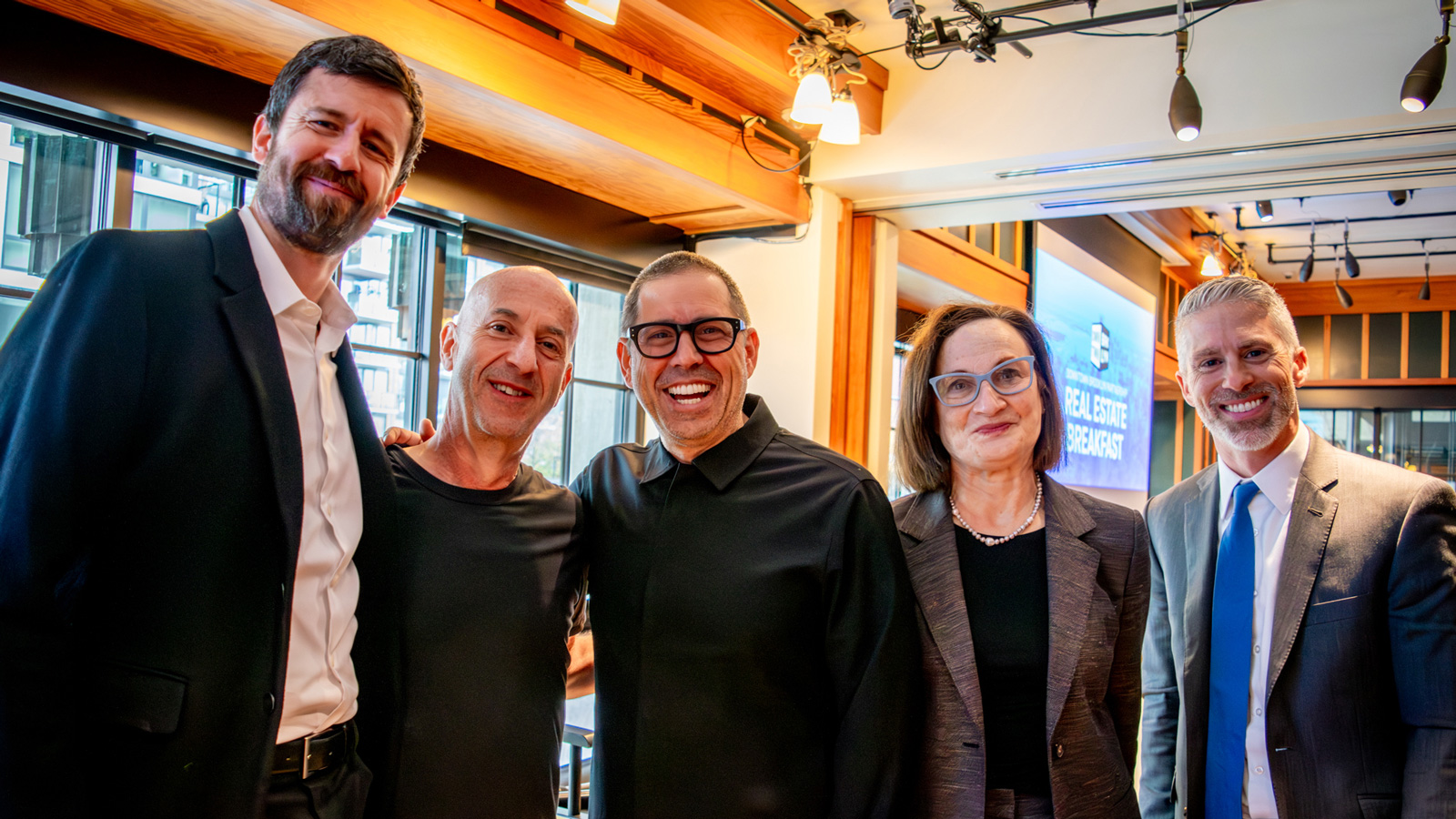
A neighborhood entering its next phase
Across both panels, the conclusion was the same: Downtown Brooklyn’s evolution is compounding. Entertainment venues are thriving, hospitality is outperforming expectations, retail is expanding, and residential demand remains strong. With major long-term investments—from Pacific Park to One Hanson to the Brooklyn Paramount—the district is solidifying its place as a cultural and economic hub for the borough and the city.
Not every piece is yet in place, but the momentum is unmistakable. Downtown Brooklyn is becoming something larger than the sum of its parts: a cultural and economic hub redefining what a 21st-century urban center can be.
Learn more about Downtown Brooklyn’s real estate market on DBP’s Why Downtown Brooklyn page.